Showing posts with label thoughts. Show all posts

Sunday, August 05, 2012

A chilling thought on a hot summer day

DRO_080512_a-chilling-thought
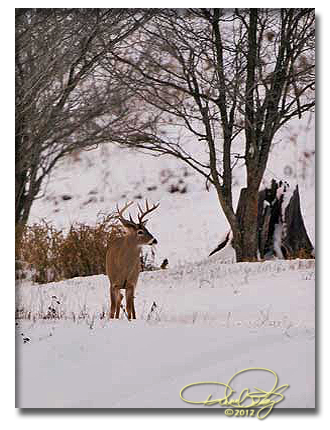
Not enough snow to prohibit deer travel … yet
photo courtesy Dave Richey Outdoors ©2012
We've all grown up with the adult advice that too much of
anything is never good for you. The primary examples used when I was a young man included such things as alcoholic beverages, tobacco and chasing wild women.

Most people realize that eating too much sweets, too many steaks or too much fried foods isn't good for a person. Too much Thanksgiving turkey bloats a person and makes us drowsy.

This "too-much" attitude can apply to many things about deer hunting as well. Too much east wind, too many trips to the same stand, too many does in the herd ... all of these things can be bad.


A chilling summer thought


Even though it is 80 degrees in early August, my thought processes are never far from deer. This leads me to wonder about snow. Can too much snow be a bad for hunters and for deer? The answer is a qualified "yes."

Let's take a look at the problem. Some parts of the state last winter were knee-deep in snow. What exactly are some of the problems associated with too much snow for hunters.
  • The obvious thing is that too much snow can have a limiting effect on how deer travel. The more snow, the less the animals move out to feed. The less feeding that takes place means that deer are not as visible, and that isn't good.
  • Another problem with too much snow is it becomes more difficult for hunters to get around, and the result is many sportsmen stop going out. They dread the idea of hiking a half-mile through deep snow, and running the risk of a heart attack.
  • We all know that snow makes things slippery, and it's very easy for a boot to slide off a tree stand step or the ladder of a ladder stand. Snow blows, can obscure moving deer, and many hunters do not care to be out in the really nasty weather.

Too much snow causes problems for deer as well; Such as


  • The deeper the snow, the less deer will move to feed. The deeper the snow, the more difficult it becomes for young deer to get around and to find food. Prolonged bouts of snowy weather and cold temperatures can lead to winter die-off or increased predation.
  • Deer spend most of their time in heavy cover, and snow can obscure the view of a deer moving through thick underbrush. Those deer that do move may pay an inordinate amount of attention to a hunting blind. They may still hang back in a thicket and not move until after dark.
  • It's difficult to tell a buck from a doe in swirling snow. They same thing applies to foggy weather. A friend of mine shot two bucks last year by accident. They looked like does, which is what he was hunting, and he glassed the deer with binoculars, and then switched to a scope. He studied their heads and could not see antlers, but when he walked up to both animals, each was a nice buck. Their antlers were made invisible by fog hanging four feet off the ground.


Swirling snow can lead to taking a bad shot


One could make the argument that he shouldn't have shot. However, long periods of studying both animals with binoculars and a high-powered scope failed to reveal antlers. He still wishes he hadn't shot.

So here we are, just barely into August, and each day brings us closer to the hunt and the inevitable snow that follows.

A friend of mine from the Traverse City area had 20 inches of snow one day last year, four inches the next and the next, four inches again and about six inches the next day. If anyone is counting that is 34 inches several day, and it continued to pile up.

Many don't seem to be aware of it, but two years ago we got 165 inches of snow that winter and about 120 inches last winter. Who knows what the weather will bring in several more month.

Granted, deer can head for the conifers where there is some thermal cover, but the combination of cold temperatures and increasingly deep snow, can place some young deer and mature breeding bucks in serious trouble early in the winter.

That, in a very bad winter, can become a death sentence for deer. And that is a chilling thought on a hot summer day.

Thursday, March 31, 2011

Betting on a buck


This big buck, framed between two maples, was patterned right.


A few of my friends have bet me with a friendly verbal wager that they would shoot a buck that night. I'd prod them a bit, and ask just how certain they are that a good buck would fall to their well-placed arrow.

Those who were staunch in their opinion said they could feel it in their bones. Now me, feeling something in my bones usually means a touch of arthritis is flaring up.

They continued to plunge on saying the wind was right, they were planning to hunt such and such a ground blind or tree stand. They had this dream formed in their mind, and I wasn't about to try swaying their thoughts.

Wishing for and planning to shoot a buck are two different things.


Their big buck, framed between hope and desire in their day-dreams, was due to show up that day at 20 yards, while accompanied by a wagon-load of luck.

Off they would go, a big sillygrin of anticipation on their face. Over many years of hunting whitetail bucks, more often than not, a hunter with such a no-fail plan would be the first to fold Double Bull tent blind when the deer decided to go elsewhere.

It's my nature to let them natter on and on, and if they ask for my opinion, I offer it for what it is worth. Some pay attention, and others just fritter away an evening of hunting without ever being within 100 yards of any kind of a buck.

Deer operate on instincts, and getting too hyped up in advance can make a hunter careless.  In their rush to get settled into the stand, something falls out of their pocket and is left laying on the ground where every nearby deer will see or smell it.

Their giddy mood often makes them a bit antsy. The beat goes on, running through their brain, and in breathless anticipation of the shot they simply know is coming, their toes are tapping the stand in time with the music playing in their head.

A buck stands back in the brush, hears a faint sound, and eventually the animal locates it high in a cedar, pine or oak tree, and heads off to visit his girlfriend 300 yards away.

Bucks may show up on schedule but they are usually young ones.


Or, our hero sits in the tree, looking a bit southwest with binoculars to his eyes, scanning the terrain for a buck. Every so often, sunlight will glint off the lens and sends a flash of light on its way. A deer that looks up just in time to see the flash of light will be suspicious and approach that area with extreme caution, if at all.

Sometimes the buck does show, and after hours of dreaming of a close and deadly shot, the bow hunter becomes all fumble-fingered, and creates too much movement as he prepares for a shot. Or, he turns slightly in the stand for a close shot, and something falls out of his pocket and goes clattering across the stand.

It could be a wallet or anything. The bow limb could rub against the tree, and some bark or pine needles could go drifting to the ground. A sharp-eyed buck will spot the falling stuff, wonder why he'd never seen it happen in that spot before, and before we know it, the buck is two fields away and still running, scared plumb out of his wits.

These things happen. I've learned never to predict a buck at the end of my hunting day. First of all, I'd have to see one I wanted to shoot, and that never happens on a regular basis.

Optimism is a great quality but keep such thoughts realistic.


I do believe in being optimistic. Feeling confident is much different than almost bragging about a buck that may not come within two miles of the hunter.

Respect for the animals we hunt is important. It's far more important than bragging about an animal that as yet has not been seen or shot. It may be time for some hunters to critically analyze the reasons why they hunt, and those who have true convictions, hunt for the sake of hunting. A buck or doe is only a bonus.

Killing a buck or doe proves very little other than the hunter was in the right place at the right time, and made a good shot. It rarely proves anything else.

Friday, December 17, 2010

Q & A about deer hunting


Green woods or snowy terrain, feel safe when drawing on a buck.


Over many years, readers have asked me countless questions about deer and deer hunting, and they are often duplicated. Each one is answered in some detail, but seldom is this information shared with other readers of my daily weblog.

Here are several questions asked of me in the past couple of weeks as we prepare for the end of the archery and muzzleloader deer seasons soon.

I could fill a book with questions I’ve answered in recent years.


Q. - Are you happy when all the deer seasons finally end after three months?

A. - No, I'm never happy to see the season end. But then, I often go out and sit in the woods and watch for deer providing they aren't yarded up. There is no bow or firearm with me, but I'm studying deer habits, travel routes, and it is all a necessary part of hunting. I'll spend an average of 87 of the 90-day season hunting, and watching it end feels like I'm losing an old friend.

Q. - What kind of a tree stand appeals to you?

A. - I enjoy an open tree stand where playing the wind is necessary. I use the Gorilla brand ladder stands made by Eastman Outdoors. They go up easy, come down easy, and put me about 15 feet off the ground. They are safe, stable, easy to climb, and work for me.

I like these easy questions.


Q. - Name your favorite trees for a tree stand? And why?

A. -- C'mon, that's too easy: Cedars. I prefer to sit back in the shadows of overhead boughs with heavy limbs on both sides. The only place I need to shoot is out in front and a bit to my left. I prefer deer to pass the stand from behind me and to my left, and that angle provides me with an easy broadside or quartering-away shot.

Q. - Do you cut shooting lanes for bow or firearm seasons?

A. - No, and here's my reason why. Remove a bunch of small trees, branches and other cover such as leaves, and it removes the reason why bucks travel in that direction. I note where deer travel, pick a hole in the brush to shoot an arrow or bullet through, and do as little to disturb the area as possible. I hear most deer before I ever see them.

Q. - How often (days in a row) will you sit in the same stand?

A. - Much depends on the circumstances, but I try to sit in a different stand every evening or morning. If I've got a a big buck coming through on a regular basis, and if the wind is in my favor for two days in a row, I will probably sit in the same spot both days. The big problem is it is very easy for deer to pattern a hunter, and it becomes easier the more often you hunt a particular stand. I get bored sitting in one stand, looking at the same trees day after day, and when we leased land, we had several tree stands and several coops or box blinds scattered around. It was easy to hunt a different stand almost every day. It paid off with good bucks.

Q. - What is your biggest fear associated with deer hunting?

A. - Getting spotted climbing into the stand or being winded. Each location has a minimum of two routes in and two out, and I always rotate how I approach a stand. Even if I hunt the same stand twice in eight days, the second time I walk to the stand is by a different route than I used a week before. I always leave the stand by a different route than when entering it. Some of my stands have three and even four ways into and away from them.

I’m now obsessed with personal safety while treestand hunting.


Q. - Any other fears?

A. - Oh, sure. I have a healthy fear of falling. I've fallen several times in the past, but was never injured. As I get older, and as my vision worsens in my remaining good right eye, I've become more obsessed with insuring greater personal safety. I began wearing a Rescue One 'CDS'  (Controlled Descent System) full-body harness from Mountaineer Sports <mountaineer-sports.com> every time I hunt from a tree.

It affords me much greater protection while climbing up a tree or ladder, climbing down, and while in the stand. I’d rather be out without my bow or firearm than be without this safety harness, ascend-descend line, and Lineman’s Safety Rope and Treestand Anchor Strap. There is a much greater peace of mind when knowing you are safe at all times.

Q. - What is the biggest problem for most archery deer hunters to solve?

A. - Playing the wind. The hunter must be downwind or down and slightly cross-wind whenever they hunt. How you avoid having deer wind you is up to you. Simply hunting only when you can have deer upwind of your position is great. Some hunters believe in Scent-Lok suits, as I do, and others believe in sprays that help eliminate human odor. Being downwind of deer offers a great advantage. If the wind switches, leave that spot to avoid being winded and blowing a good stand.

Q. - Do you wear rubber boots? Are you that fanatical?

A. - Yes, I am that fanatical. Most of the time I wear knee-high rubber boots, but if I must walk through tall marsh grass I'll often wear hip-boots or rubber waders. Years ago, when I wore leather boots, more than one deer trailed me to my stand. They don't trail me now. I also try not to touch any vegetation with my clothing or skin.

Q. - Why do you pass up bucks that others would shoot?

A. - That's easy. I've shot over 270 deer during my lifetime, and no longer derive any satisfaction from shooting small bucks. I'd rather hunt for an old doe because they offer more of a challenge than a young buck. Hunting doesn't always mean a kill for me, and if a wee 6-point comes by, I draw and aim as if I'm going to shoot, and then ease off and let him walk. I no longer need to kill a buck every year, and I didn't shoot one during last season, but passed up numerous bucks I could have shot. Passing up bucks can be more fun than shooting one because it means you've completely fooled them.

Stay tuned and we'll do this (answering questions) again soon.

Posted via email from Dave Richey Outdoors

Thursday, October 22, 2009

Do Thought Waves Spook Deer?

Ever see a buck coming through the woods and suddenly it turns and runs off for no apparent reason?  Have you ever had a doe upwind of your stand stop, snort, blow, stomp her foot and run off even though the wind was right and you hadn't moved?

Sure you have. The  topic of discussion that follows may disturb some hunters, could cause other sportsmen to wonder if this topic is true, and if so, how does it happen?

Trust me on this: This topic will be a quantum leap for some deer hunters when they read it. I've stated these opinions at deer-hunting seminars over many years, and some folks sit with their mouth agape in total disbelief.They look as if they've been sucker-punched.

Don't bail out on me just yet. These thoughts, if you choose to accept and think logically about them, may make you a much better deer hunter. We'll be talking more about your mental thoughts rather than physical actions.

My many years of testing this theory

It's not important that hunters believe as I do, but over 30-plus years I've tested this theory on countless occasions. Each time it's tested, the result is the same. I strongly believe what follows is true, and all I expect of readers is to study it and decide if they believe and trust these findings.

Know this before we go any further. There is much that modern science doesn't know about the brain, brain waves, and how it affects people and many of the wild animals that we hunt.

My thoughts on spooking deer

Here goes: I believe, being a supremely capable and knowledgable predator, that deer -- especially does -- can sense the presence of danger without the benefit of movement, noise or scent or other stimuli. I once hunted mountain lions in northern Arizona, and my guide told me the reason he feels cougars kill mostly mule deer bucks is because those deer are so full of themselves they act and feel immune to any possible danger.

They are not alert or attuned to the presence of danger. Does, on the other hand, are constantly alert to the possibility of nearby predators.

My thoughts are pretty straight-forward. I believe that thinking hard about killing an incoming buck or doe can transfer some type of danger signal to the animals. Are human thoughts carried by brain waves? Do these vibes, for lack of a better description, throw out a silent alarm that does can pick it up much easier than bucks?

Clear your mind of all predatory thoughts

I never think, after spotting an incoming buck or doe, that I am going to shoot that animal. My brain stays in neutral, idling along without conscious thought. I purposely avoid thinking about shooting and killing the animal. I may and often do spend that time thinking about my next article to be written.

My belief is to never stare at a buck or doe. Looking into a deer's eyes seems to allow that animal to feel nearby human presence. My thoughts remain neutral, and when I draw, aim and shoot, I'm concentrating on my aiming point but am not thinking about killing the animal.

Testing this theory over many years has proven informative. My normal hunting method is to allow my eyes to sweep over the deer without lingering on any part of its head or body. It's easy to establish the animal is a buck if antlers are visible, and that data is stored in my mind. I know it is a buck but no longer think about it, and I never dwell on such thoughts, which I feel are counterproductive to my hunting success.

Instead, I think about going hunting the next night, which stand may be productive under the current wind direction, or I'll recall something that has absolutely nothing to do with hunting. I could just as easily be thinking about painting the basement walls, which is a horrid thought, even when trying to fool a nice buck.

My means of nonviolent thoughts

However, my mind knows why I'm out there, and that is to possibly shoot a buck or doe. However, my mind focuses on another thought or topic, or on nothing at all, and when it tells me it's time to shoot, the bow is drawn, the red-dot settles behind the front shoulder and the arrow is gone before my mind tells my finger to shoot.

The deer never senses a threat or any unease. It doesn't feel my predatory instincts coming its way, and the deer remains relaxed. Calm and cool thoughts or even not thinking at all is far preferable than telling yourself that the shot will go through its lungs and heart. That may happen, but if you don't think hard on it, I'm convinced the deer will not bolt unless you move or make a sound at the wrong time.

On the other hand, I've often thought about killing the buck as a specific test. I'll think: Here comes a buck, and look at those antlers. My eyes scan the bone on the buck's head, and then I strongly focus my attention on the heart-lung area.

The buck, suddenly alert, turns his head to look around. My eyes lock on his, a predator against a nice buck. His head turns slowly away, and I come to full draw, think about driving the arrow into the chest cavity, and at about that time, the animal suddenly bolts off in panicked flight.

There has been no noise or sudden movements on my part, and no way the deer could smell me. But my thoughts were keenly focused on shooting that animal, and perhaps these strong thoughts come because of my many years of hunting experience shooting many deer. Perhaps my vibes are stronger than those of others who have largely been unsuccessful at deer hunting.

A human example to illustrate my point

Think of it this way. I no longer drink, but back in the day, my entering a bar was always an experience. If I was a stranger, I'd immediately sense the vibes of many other people looking at me, and then would come a strong feeling that someone was staring intently in my direction. With practiced determination, my eyes would scan the room until the person staring at me was located.

It was then I'd size up the situation. Is this a friendly person or one who wants to put knuckle bumps on my noggin? If I sense agitation or aggressive hostility, I'd turn and walk out while it's possible. It's the same thing with deer. Flight is always preferable to a fight.

An example of street smarts

In some areas they often say a person has "street smarts." Why, pray tell, don't deer have "woods smarts?" They do, and their instincts are more finely honed toward survival than yours or mine.

If deer sense danger, however it is transmitted to them, it becomes an instinctive reaction. It's like an adrenalin rush: it triggers the fight or flight response. Deer don't grow large antlers by ignoring these little niggling feelings. I draw the line at granting deer human-like qualities, but am convinced these animals can pick up hostile vibes from someone trying to shoot it with a bow.

Deer can do the same thing as humans although how they process this invisible information is an unknown factor. Years ago, while shooting some of the deer photos needed for magazine and newspaper stories, the deer would hear the shutter click, look around, and nothing happened. Minutes later another photo or two would be taken, and the deer would become used to the noise. Nothing happens, and they would soon relax.

It's strange but deer seem to sense when a hunter or photographer means no harm, and while an old doe may go charging off, if they are not unduly alarmed, they often return within minutes.

Deer that sense a hunter intent on shooting them can get as freaky as a mule deer doe when she suspects a nearby cougar. She doesn't want to be dinner, and takes whatever evasive actions are necessary to avoid the predator. Bucks, on the other hand, seem unaware of danger unless it picks up some predatory vibes, catches a whiff of human odor or sees some movement.

This is where it becomes extremely important to remain in a non-predatory mind set. Think about killing, and things can quickly change and game can vanish.

A quick recap

Never look deer in the eye, never think about shooting them, scan past the animal, never put a lingering stare on the deer or its antlers, and if I'm about to shoot, my mind is emptied of all predatory thoughts. Ninety-five percent (or more) of the deer that have fallen to my arrows were dead before they knew their lives were in danger.

I repeat: it's not necessary that you or anyone believe this, and hunters can continue to hunt as they choose. However, when I hunt, my purpose is to get close to deer, never get them excited, and if the right buck comes by, I'll take the shot. Cougars hunt the same way and they are far more deadly predators than most humans.

It's quite likely this may be the most radical bit of deer hunting material you'll read this year. I'm not trying to change your hunting style or your mind-set, but ask you to consider an alternative line of thinking when deer approach. Many of the key hunters in North America, if pinned to the floor with a painful hammerlock, will agree with these thoughts. All I'm taking is your time (the line from an old song), and my hopes are you'll give this the mental consideration it deserves.

Feel free to share your thoughts. Do you agree or disagree? Your comments, please. E-mail me your thoughts at < dave@daverichey.com >. Thank you for your time.

Posted via email from Dave Richey Outdoors