Showing posts with label urine. Show all posts

Friday, March 04, 2011

Winter thoughts on the whitetail rut

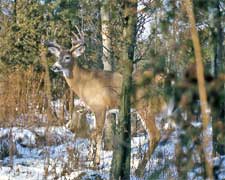
Look at the neck on this rutting buck. He’s a nice buck anywhere.

The buck was banging its antlers against a tree, and I listened to him working a scrape for 30 minutes late last October. The buck was within 20 yards of me but he was screened by thick brush and invisible.

I sat in my tree stand and listened. He was close enough to hear the urine hitting the scrape, and he was upwind and the pungent ammonia odor was strong. He worked that tree over, yanked at the overhead licking branch, and for all the noise and commotion he made, the buck was impossible to see.

I checked the spot the next day. He'd been working two scrapes, and one was eight inches deep and as big around as two large platters. The buck had pulled the old licking branch down, and I replaced it. It suited him because the scrape had tine marks and a hoof print in it, and the new licking branch looked pretty ragged. The second scrape was opened up, and the licking branch was chewed to a frazzle.

Find a new scrape, and check it tomorrow. Hunt nearby if it’s been reopened.

What was even more interesting was that the buck had opened up a third scrape. Huge clots of wet earth was piled at the north end of the scrape, and he had made it the night before. How do I know?

Buck scrapes have dirt and debris piled at one end or another, and if the dirt is piled at the end closest to thick cover, it generally means the deer is tending that scrape in the evening as he leaves the bedding area for a night of chasing cute little does.

This told me several things: One is the rut had not started but the chasing phase had set in. This chasing phase lasts several days before the full rut starts. As long as fresh activity is seen at the scrape, and it is being tended one or more times daily, the rut has not begun. Once the scrapes show no sign of activity, that means the rut is underway.

One thing few hunters realize is that the mid-day hours just before and during the rut can produce a fine buck. This buck may have other nearby scrapes that it had been working, but once a buck is shot and is taken out of the woods, another will take its place. Nature abhors a vacuum, and when a big brown trout or a big whitetail buck is removed, another moves in and takes over.

The mid-day hours are a great time to hunt during the rut.

Hunting from 10 a.m. to 2 p.m. works well during the chasing stage and the rut. If possible, be in your stand by 9 a.m., and sit patiently. The bucks will move during the mid-day hours.

I first learned of this phenomenon many years ago while hunting ruffed grouse. Two days in a row a buck was seen darting away from me in the same area. I checked the area, found his scrapes, and went back and set up a stand 30 yards downwind of it. The buck came by that first day at about noon, wind-checked the scrape from downwind, and offered me a 12-yard shot.

Hunting the pre-rut and the rut during mid-day hours can pay off. Sure, many can't take time off work to hunt those hours, but keep it in mind for weekends. Hunt near natural funnels between bedding and feeding areas, and once the rut kicks in, start hunting the heavier cover.

My only real problem with hunting the mid-day hours is a personal one. I'm good for three hours maximum in a tree before everything gets sore. I'll stick it out until about 2:30 p.m., grab a bite to eat, and then hunt from 4 p.m. until legal shooting time ends. It means spending long hours in a tree, but it can pay big dividends with a husky whitetail buck.

This method has worked for me, and can work for you regardless of where you hunt. Try it this fall and see if it doesn't produce action at a time when no one is hunting. It's rut hunting's biggest secret, and now only you, me and several hundred thousand other people will know.

Posted via email from Dave Richey Outdoors

Friday, October 23, 2009

Hunting Pre-Rut Bucks

Pre-rut deer are like a walking billboard. They advertise themselves in many ways, and savvy hunters may want to bone up on some of the pertinent data that bucks leave behind as they travel around their home turf.

Deer scrapes are where you can find them during the pre-rut. Those scrapes found along field edges often are "boundary scrapes" that mark the edge of a deer's normal range. They are usually small, and somewhat regularly spaced along a wooded field edge.

A deer will open them up, and may never return again. They serve little purpose other than to mark their personal range. I've seen cases where 10 or 12 scrapes will follow a field edge, and once opened, they are never touched again. A string of boundary scrapes should not be confused with a scrape line or a rub line.

When do bucks visit hot scrapes?

The really hot and active scrapes may be visited several times every day, and most of them will be found in fairly thick, heavy cover although some of the largest scrapes I've ever seen were located in a grove of sparse pines.

The scrapes in that area were all as big as a washtub, and every one had fresh urine, a hoof print and antler tine marks in them. Each one had a licking branch directly above the scrape, and most of the nearby pine trees were nearly girdled by the rakings of a large buck. Know this that a really big and hot buck may yank the licking branch down but I've had great success by tying a new limb in its place

I hunted that area several times over two years, and eventually the big rubs and scrapes disappeared. The buck was working on trees 10 to 12 inches in diameter. It would take a huge buck to do that kind of damage, and I never heard of such a buck being taken and it's likely he died of old age. He may never have been seen.

Some tips on scrapes and what they can tell you

Some of what follows may seem elementary but it's important stuff to know. Fresh and actively maintained scrapes are round or oval in shape, and sometimes one will overlap into another scrape. The ground is pawed away until all grass, leaves and twigs are scattered away.

Nearby trees often feature smooth bark but I've seen many rubs on cedar and pine trees as well as popple, tag alder and maple.

A scrape offers great indications about when the buck is visits and works the scrape, and the clues are easy to spot. Most, if not all, of the pawing will be done in one direction. The dirt, grass, leaves and twigs will pile up at one end of the scrape.

If the dirt is piled up at the end of the scrape closest to thick cover, it usually means the buck is visiting it in late afternoon or early evening while leaving his bedding cover. Dirt piled at the end closest to open feeding fields often are visited in the early morning as the buck heads for heavy cover to bed down.

New or old? Good question, and easily answered. Some scrapes are made, and then abandoned. Perhaps the animal was spooked by a hunter, and went elsewhere. Active scrapes are damp with urine, and often feature one or more hoof-prints and/or antler tine marks.

Old and abandoned scrapes fill in with grass and fallen leaves. An active scrape will be cleaned of all debris once to several times a day, because this is where the buck wants to meet an estrus doe. Of course, bucks and does often meet in open fields or woodlands but the initial contact usually occurs near an active scrape.

Scrape hunting can be exciting

Watching a buck work a scrape is really neat. A young buck knows he is supposed to be doing something but he doesn't have a clue. A buck with some age will often wind-check the scrape from downwind, and if it appears to have been visited by an estrus doe, the buck will tend the scrape.

He will paw the dirt, nibble on the overhead licking branch, rub his forehead scent glands on the overhead branches, urinate in the scrape, paw and stomp it into mud, and hang around nearby. This is when a hunter may get a chance for a shot if he is positioned properly.

Some does often hang close by waiting for the buck, and sometimes, the buck will follow the doe's trail. Such tending bucks often give a low grunt as they follow the hot trail. Bucks usually wind-check active scrapes 20-30 yards downwind of the scrape. The hunter, if he sits 40 yards downwind of the scrape can often  intercept the buck coming through and wind-checking as he walks through the arera

Scrapes full of debris are not being used. Scrapes can go from hot to cold overnight, and a previously active scrape that shows no use provides hunters with another important clue. An active scrape that suddenly shows no use means just one thing: the rut has started.

Rut hunting is a fascinating time to be afield but remember the hours of 10 a.m. and 2 p.m. are mid-day hours that bucks prefer. The bucks can appear at any time during the day, and watching a randy old buck hot on the trail of a young doe gives us all hope. Maybe, just maybe, she will lead him past our stand.

One can only hope. Waylaying a nice buck near a scrape does happen but the hunter must always be ready. Big bucks rarely offer a second chance.

Posted via email from Dave Richey Outdoors