Showing posts with label our. Show all posts

Monday, May 09, 2011

Helping others understand the outdoors

photos & montage by i65design


The author in a pensive mood about the future of outdoor writing.


There are many important things in life, but being a full-time outdoor writer is my profession and that makes me feel good doing what I most enjoy doing.

I'm long past the stage where seeing my name in print is needed to provide an ego stroke. There are other, far more important things in my life ... like helping others understand the outdoors.

This is my 45th year of writing about the great outdoors. I wrote my first magazine article in 1967 and sold it to Sports Afield. The next five stories also were sold to outdoor magazines with another going to Sports Afield.

Success came slowly, and required a great deal of hard work.


Then came two hard years of rejected slips, and as time went on, more and more stories were sold. I began with a goal of writing for each of the Big 3 magazines -- Field & Stream, Outdoor Life and Sports Afield -- and it took four years of hard work to make at least one sale to all three.

My next goal was to sell to as many magazines as possible. That led to sales to well over 300 different magazines before I quit counting, and there has been more than 7,300 published magazine articles since that first one many years ago.

My ultimate goal was to become one of the most widely published outdoor writers ever, and although I no longer strive to fulfill that goal, I am, without meaning to brag, at or very near the top of the heap in terms of magazine articles sold. I worked pretty much full-time for Outdoor Life magazines for more than six years, and one year had over 140 articles published in that magazine alone.

That was then, and I doubt if such sales are possible now. The roster of outdoor magazines has crumpled in some regards, but in the field around which I built my career, the number of outdoor magazines are tumbling. As gas prices soar and car sales level out, advertising revenues have fallen. Magazines that once flourished are sinking fast or have sunk below the sea of advertising losses.

Somewhere along the way, another of my many writing goals was to write books. To date, I've written 25 on fishing and hunting. Thousands of magazine covers and inside black-and-white and color photos have been published over the years.

I've had my own radio outdoor show, appeared on countless television programs with a wide ranging host of outdoor celebrities. I guided trout and salmon fishermen for 10 years, guided bear and deer hunters for four years, and led hunts for bear and caribou.

My travels have taken me all across North America and to within several hundred miles of the North Pole, and as far away as New Zealand. I've fished for, and hunted for, every species of animal, bird or fish that would ever turn my crank.

Gaining credentials and becoming known was an arduous and long path.


I've given thousands of lectures, been a platform speaker for many years, and had a 20-year emcee job at the Detroit Boat & Fishing Show. I've given private and public seminars, and all through my 45 years, I've done what I wanted to do and went where I wanted to go. Like Frank Sinatra once sang: I did it my way.

Out of all of this travel, and after so many outdoor experiences, has come this wealth of work. I count, among my many joys, being an Active and now a Life member of the Outdoor Writers Association of America (OWAA), as one of the greatest successes in my career.

OWAA became a part of my life in 1968, and I attended my first conference in 1969. I've attended every OWAA conference since 1976 in Snowmass, Colorado, and have chaired or served on perhaps 50 different OWAA committees.

I've been truly honored by having been awarded the Ham Brown Award, OWAA's highest member award, and the Excellence in Craft Award. They also named me a Legendary outdoor Communicator in 2005, and the National Fresh Water Fishing Hall of Fame inducted me into their prestigious Hall of Fame in 2006 as a Legendary Communicator.

Guess what? All of this is very important to me, but there is something even more important behind this massive 45-year body of work. It is a very simple personal philosophy: What Goes Around, Comes Around. If you give of yourself, you’ll gain satisfaction and success.

I've given freely of my time all these years to help other writers. I never viewed another writer as a competitor. Every chance I've had to help someone become a better outdoor writer, I've given freely of my time ... without any consideration of pay. OWAA has a Mentor Program, but I'd been mentoring writers for many years before the organization chose to allow some of us graybeards to share our knowledge with others.

Is this sharing of knowledge important? Certainly. It's just as important as having parents or guardians mentor youngsters about fishing and hunting. If we don't teach our children, why would they consider these outdoor pastimes in the near future? The answer is, they won't.

If I, and others, don't give of ourselves to help mentor and teach beginning outdoor writers and sportsmen, who will carry this torch of fishing and hunting freedom and our legacy into the foreseeable future?

I've given of my energy, talent and time to mentor outdoor writers and to mentor children. There no longer is a need for me to make a name for myself. I'm happily content to write my daily weblogs like this one about fishing and hunting, and am equally content to bask in whatever glory has come my way over these many years.

Awards are great but helping others has been my longstanding goal.


But all awards and honors aside, what makes me feel best is to write things people want to read, and to help mentor people who wish to become outdoor writers. Someday, in the future, once my race has been run, all I care for is to be remembered as being a good person, a good parent, a good husband, a good writer, and someone who always stepped forward to help readers understand more about the outdoors.

For me, that would be sufficient. And, I hasten to add this: Remember, that it's nice to be important, but it's more important to be nice.

Thursday, December 09, 2010

Michigan’s grayling are gone again


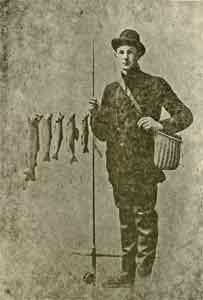
These grayling came from Bear Creek in 1890s. Bert Winnie, Traverse City.


The Michigan grayling were so plentiful 125 to 150 years ago that they were caught by the dozens to eat. Some timber companies of the 1880s fed these tasty game fish to the loggers who were cutting down trees nearby.

The fish with the overly large dorsal fin sustained the men who would ultimately destroy them. As large standing timber along streams were cut to allow more sunlight on the river surface, and the trees were rolled into the rivers to gouge out spawning gravel or clog it with sawdust, the beginning of the end was underway.

Over-fishing, timbering, warming of the stream water, and removal of spawning gravel made the inevitable demise of the Michigan grayling a certainty. Some Lower Peninsula streams held grayling until the early 1900s, and a few grayling were found in the Upper Peninsula, until the fish went extinct in the late 1930s.

Grayling were extinct in Michigan by the mid-1930s.


Waters such as the AuSable, AuGres, Black, Boardman, Boyne,  Cheboygan, Hersey, Jordan, Manistee, Muskegon, Pine and Rifle rivers once held the majority of grayling in this state. Studying data from a book called Trout of Michigan, by Harold Hinsdill Smedley (books from me for $10 plus $3 postage <dave@daverichey.com>), and from a little monograph called The Grayling In Michigan by Charles W. and Edwin P. Creaser of Alma, it quickly becomes apparent that the Michigan grayling went extinct soon after logging ended.

The last holdout for the Michigan grayling was in Houghton County's Otter River where fair to good numbers of fish were still available in the early 1900s. Michigan tried to raise Otter River fish in downstate hatcheries, and many were planted (including some in the Cedar River near Gladwin) but all such plants soon died out.

Other planting efforts took place with the last major plantings of hatchery-reared fish from Alaska and Montana, were made in the 1980s. The fish were planted in the AuSable and Manistee rivers, and in a few small Upper Peninsula streams, and in a few select lakes in both peninsulas, but after three years they had vanished without a trace.

To the best of my knowledge, the Michigan grayling were gone again by the mid-1980s. The last recorded true Michigan grayling was caught in the Otter River in 1935, and the game fish was declared extinct soon after.

It’s doubtful that grayling could survive now in Michigan lakes and streams.


I've caught Arctic grayling in northern Saskatchewan, Canada's Northwest Territories, and in Alaska. I truly wanted to catch a Michigan grayling after the most recent plants 20-some years ago, but even though they had to be released alive if hooked, I didn't want to jeopardize the fish.

Apparently it wouldn't have made much difference because the fish soon disappeared. Grayling did live a bit longer in the cold inland lakes, but I suspect other game fish ate the small grayling for lunch.

The original grayling of this state averaged 8-11 inches with an occasional fish to 14 inches. By comparison, I landed a 4 1/2-pounder in Great Bear Lake in the Northwest Territories. It was mounted in all of its majestic colors, and some slob stole it from a display at the Outdoorama show at the State Fairgrounds in Detroit in the early 1980s.

The large sail-like dorsal fin allowed these fish to put up a good fight. It was like battling a big bluegill when the fish turns its side to the pull of the line. Grayling threw up that big dorsal fin, and the fight becane more difficult. They are wonderful to eat.

The two photos above are both old-timers taken when grayling still survived.


The b/w creel photo above was taken by a gentleman named Hanselman of Ann Arbor about 1886 and shows a nice catch of Michigan grayling from Bear Creek, a Manistee River tributary.

The other b/w photo is of the late Bert Winnie of Traverse City, and was taken about 1894, and may be one of the last photos that exist of a Boardman River grayling. The grayling is the second fish from Winnie's right hand. It has a big dorsal fin.

The grayling in this state are gone, and will probably never be seen in our waters again. However, the city of Grayling owes its name to this great game fish that, like the passenger pigeon, is now extirpated. And state residents are much poorer for that loss.

The Michigan grayling were so plentiful 125 to 150 years ago that they were caught by the dozens to eat. Some timber companies of the 1880s fed these tasty game fish to the loggers who were cutting down trees nearby.

The fish with the overly large dorsal fin sustained the men who would ultimately destroy them. As large standing timber along streams were cut to allow more sunlight on the river surface, and the trees were rolled into the rivers to gouge out spawning gravel or clog it with sawdust, the beginning of the end was underway.

Many factors conspired against Michigan grayling’s survival.


Over-fishing, timbering, warming of the stream water, and removal of spawning gravel made the inevitable demise of the Michigan grayling a certainty. Some Lower Peninsula streams held grayling until the early 1900s, and a few grayling were found in the Upper Peninsula, until the fish went extinct in the late 1930s.

Waters such as the AuSable, AuGres, Black, Boardman, Boyne,  Cheboygan, Hersey, Jordan, Manistee, Muskegon, Pine and Rifle rivers once held the majority of grayling in this state. Studying data from a book called Trout of Michigan, by Harold Hinsdill Smedley (books from me for $10 plus $3 postage <dave@daverichey.com>), and from a little monograph called The Grayling In Michigan by Charles W. and Edwin P. Creaser of Alma, it quickly becomes apparent that the Michigan grayling went extinct soon after logging ended.

The last holdout for the Michigan grayling was in Houghton County's Otter River where fair to good numbers of fish were still available in the early 1900s. Michigan tried to raise Otter River fish in downstate hatcheries, and many were planted (including some in the Cedar River near Gladwin) but all such plants soon died out.

Other planting efforts took place with the last major plantings of hatchery-reared fish from Alaska and Montana, were made in the 1980s. The fish were planted in the AuSable and Manistee rivers, and in a few small Upper Peninsula streams, and in a few select lakes in both peninsulas, but after three years they had vanished without a trace.

To the best of my knowledge, the Michigan grayling were gone again by the mid-1980s. The last recorded true Michigan grayling was caught in the Otter River in 1935, and the game fish was declared extinct soon after.

I've caught Arctic grayling in northern Saskatchewan, Canada's Northwest Territories, and in Alaska. I truly wanted to catch a Michigan grayling after the most recent plants 20-some years ago, but even though they had to be released alive if hooked, I didn't want to jeopardize the fish.

Apparently it wouldn't have made much difference because the fish soon disappeared. Grayling did live a bit longer in the cold inland lakes, but I suspect other game fish ate the small grayling for lunch.

The original grayling of this state averaged 8-11 inches with an occasional fish to 14 inches. By comparison, I landed a 4 1/2-pounder in Great Bear Lake in the Northwest Territories. It was mounted in all of its majestic colors, and some slob stole it from a display at the Outdoorama show at the State Fairgrounds in Detroit in the early 1980s.

The large sail-like dorsal fin allowed these fish to put up a good fight. It was like battling a big bluegill when the fish turns its side to the pull of the line. Grayling threw up that big dorsal fin, and the fight becane more difficult. They are wonderful to eat.

A few details exist about the above photos.


The b/w creel photo was taken by a gentleman named Hanselman of Ann Arbor about 1886 and shows a nice catch of Michigan grayling from Bear Creek, a Manistee River tributary.

The other b/w photo is of the late Bert Winnie of Traverse City, and was taken about 1894, and may be one of the last photos taken of a Boardman River grayling. The grayling is the second fish from Winnie's right hand.

The grayling in this state are gone, and will probably never be seen in our waters again. However, the city of Grayling owes its name to this great game fish that, like the passenger pigeon, is now extirpated. And state residents are much poorer for that loss.

Posted via email from Dave Richey Outdoors