Showing posts with label favor. Show all posts

Wednesday, July 27, 2011

Camera or Bow: Which is best?

Photographing wild whitetail bucks requires as much skill as hunting them.

It was one of those great nights a few tears ago when the deer started moving early on a west wind, and continued filtering through my area until after dark. It presented me with a dilemma.

Should I shoot a buck with my compound bow or with a camera? The new Canon camera with a 300mm lens seemed to beckon hard and long for my use, and because it is newer than the bow, I left the bow in its case at home.

The first deer came along the edge of a funnel between two tag alder thickets. It was an adult doe, and lacking anything better to do, I watched her come for 200 yards. She stopped once, looked back, and hauled butt toward me and she was weaving in and out of the tags.

Knowing where to set up for taking good photos works just as well when hunting.

Her body language told me all I needed to know. She was trying to stay ahead of a trailing buck, and she squirted out in front of me. She stopped just out into the field, stood momentarily, and kept moving.

Two minutes later, as silent as a shadow, came the 8-point. He had five-inch brow tines, and had all the makings of a good buck with one more year on him. I clicked off several photos as he stepped out of the snowy alders where she had run out, and he trotted head-down to the place where she had stopped 15 yards from me, and came to a broadside halt.

I got another photo as he came to a stop, and he apparently didn't hear the camera shutter clunk, but off he went in hot pursuit. Then minutes later two does and four button bucks and doe fawns passed, and they too were looking over their shoulder. I clicked a few photos of them passing by, and then all was silent and still for several minutes.

The wind was switching from southwest to west to northwest, and back again. My stand was perfect for the wind, and it gave me a good view of the funnel these deer were using. They often would step out into the field rather than cross the two-track trail in heavy cover.

There's not a lot of traffic down this trail, and my stand was 150 yards from it. The deer seem to favor a more open view of the area rather than to be caught in heavy cover with a car coming. I found it a bit odd, but it seemed to be a local quirk of these animals.

A knowledge of deer habits is very important when shooting photographs.
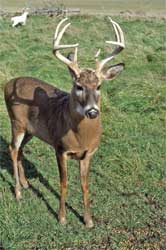
A half-hour passed, and I could see a few deer across a wide-open field, and those animals were heading elsewhere. They weren't heading in my direction.

Fifteen minutes before shooting time ended, a small doe was seen being chased by a spike, and she came busting down through the funnel, jumped out of the tag alders and never slowed down near me. The spike had twin six-inch daggers growing out of his head, and it's possible the doe was more concerned about rough stuff with those spikes than being bred by him.

A minute later a pair of year-and-a-half-old bucks, one a 7-point and his buddy had 8 points, walked past my stand just inside the brush. I snapped some photos of them, and they were on their way.

A friend was coming to pick me up, and I stayed in my stand to await his arrival. His vehicle would spook away any deer, and it would help me avoid scaring off any deer within sight of my stand.

Having a friend walk or drive in to pick you up works great. They will be gone before you can get down.

Shooting light came and went, and I stowed my camera and sat quietly with binoculars in my hands. Two antlerless deer were seen 200 yards away, moving south and away from me, and as I sat waiting patiently, a buck slipped out of the brush and paused, 15 yards away.

I could see white atop his head, and what appeared to be a goodly amount of it. This buck came from out of nowhere, and he wasn't seen until he was spotted standing there. He was upwind of me, and where he paused was where the doe had stopped.

He sniffed around, sorted out the odors of the doe, the other bucks and fawns, and headed into the tag alder funnel and disappeared from sight. He may have went north or south, but it was too dark to tell.

My buddy soon arrived, picked me up, and we discussed what photo ops each of had had. He had seen more deer than me, and he didn't have a bow with him either.

Perhaps, another evening will be a bow night. I'm not terribly picky, but I'm always looking for something great. I may have to settle for an antlerless deer or two this year, but I don't care. I've taken too many smaller bucks, and I'd just as soon take a doe as a small rack.

I'm not a trophy hunter. I'm a realist, and would rather see those small bucks grow into big bucks. A doe eats as well or better than a buck, and in the meantime, I can always shoot photos.

Posted via email from Dave Richey Outdoors

Thursday, October 29, 2009

10/29/09_droblog_Wounded Deer Do Not Always Die

Many years ago I was hunting a local area, and I kept seeing a really nice buck. I had a strong feeling that something was wrong with the animal but had no visible clues.

I glassed it with binoculars and even a spotting scope, studied it from all angles, and didn't want to waste my tag on it if the buck had been wounded. There was no noticeable limp, no legs dragging, and no apparent sign the buck was hurt in any way.

Still, a niggling thought kept coming back to me: this buck is hurt. Should I shoot it?

A tough question to answer

There were too many questions and no logical answers. The next day I sat in a tree stand overlooking a nearby trail. I'd seen the buck travel both ways on this trail, and the only thing that I hung my suspicions on, was the fact that this buck seemed to move too slowly to be in good health.

I'd been in my tree stand for an hour when I saw him walk out of a marsh. Tall marsh grass covered  most of his body but beautiful points stood high above his head. He moved very slowly, and didn't appear to favor either leg, but the more I watched him, they greater my feelings that this buck was in pain. The noticeable hump on the right front shoulder was difficult to see back inn heavy cover.

He approached my stand, and the wind was in my favor. He hung back, and two or three does and fawns, squirted past my stand, and he stood motionless for 10 minutes. The other deer were out of sight when he decided to step out into the open.

Each step was slow and methodical, a study in caution. He stayed screened by brush for long minutes as he took a step or two, stopped and studied the terrain all around him. He acted as if he had been shot at before by a bow hunter, and wasn't taking any chances of it happening again.

Apparently satisfied, he took two or three more steps, and exposed his vitals to a broadside shot. I waited, and he turned his head in the direction that the does and fawns had traveled, and I eased back to full draw and made a smooth release.

Taking the shot

The Carbon Express arrow sliced in low behind his front shoulder, hitting the heart and lungs, and his back legs kicked backward as it appeared to hump up slightly, and off he ran out of sight. I heard the buck go down, and it was a simple trailing job. I followed the Game Tracker line, and found the buck dead 70 yards away.

I field dressed the animal, and the meat near his shoulder was green. I kept skinning him out on that side, and the more hide I removed, the more green tissue I found.

This deer had gangrene all through its body, and even though there was no reason to suspect it was ill, a further autopsy proved the cause. The buck had been hit high in the shoulder, and the three-blade replaceable-blade broadhead had broken apart on impact.

The hunter who had originally shot the buck had been hunting from a tree stand, and the broadhead had penetrated until the replaceable blades impacted on the top of the shoulder blade. I kept skinning, and eventually found the tip and three bladess buried under the hide.

Gangrene had set in

The buck had been hit several days before, and it was in a spot where the animal couldn't lick the wound, and it just kept getting sicker by the day. The hunter couldn't recover the buck because the arrow wound wasn't that bad, but as time went on, a major infection set in.

This buck walked normally, didn't favor the leg on that side, and it wasn't the broadhead that would have eventually killed that buck if I hadn't shot it, but it was slowly dying from a nasty infection.

The buck was useless to me or anyone else, and I informed the DNR about the animal, and they said to leave it to the coyotes. I took photos of the broken broadhead, and two days later the coyotes had reduced the carcass to bones and hair and saved that animal from being eaten alive.

A deer, hit in a non-vital area that it can lick and keep clean, will almost always survive. It's such animals as this that become almost impossible to hunt. I've killed many deer that have been wounded by other people, and in many cases the deer would have survived.

A wounded deer doesn't always die. In fact, studies have shown that if blood loss is kept to a minimum, and no internal organs or major blood vessels are cut, the chances of a successful recovery are good. However, minor flesh wounds will heal quickly and often within a week or less, the animal will be up and moving around.

Know this, though A deer that recovers from an arrow wound is one savvy animal. Shooting and killing that deer can be a supreme hunting challenges of all.

Posted via email from Dave Richey Outdoors