Showing posts with label coyote. Show all posts

Thursday, January 06, 2011

How many turkey calls?


A sampling some key turkey calls I’ve used for years. How many do I have?


It's been troubling me. The question concerns how many turkey calls I own. Got no clue so the only resource is to count them.

I went through the diaphragm calls, the owl hooters, wingbone yelpers, box calls, crow calls, push-pull and all the friction and slate calls.

Take a guess. How many turkey calls do I own?


Almost everything I do goes to one extreme or another. Too many? I personally think, like with fishing or hunting books, one can never have too many turkey calls. I doesn't help that I seem to lose a few each hunting season, try to find them, give up and wind up buying more.

There was a preliminary guess that I made before going through my turkey hunting vest and all my spare calls, and I was off by a good bit. Nope, I'm not going to tell you whether my guess was high or low.

Instead, I choose to make it a guessing game for readers. How many turkey calls do you think I own? Email me at <dave@daverichey.com>, and give me your total count. Leave your name abd address with your guess, and a week from now, I will see who guessed closest to the total of all turkey calls.

I will pick two winners, those that guess exactly the total number or are the closest to the total number. Each one will receive a free autographed copy of my book "Hunting Michigan Whitetails." It will take just a minute to guess the number of calls, and send me an email with your name. Put the word "Calls" in the memo line of your email.

Keep in mind, this includes all locator calls (be it a crow, owl or screaming peacock or whatever). It also will include box calls (including my working calls and collector models that are not used).

This question involves all types of turkey calls.


Also included will be my wingbone calls, and here I'll give you a hint. Wingbone calls are fairly scarce in my collection, and I've never practices each with them to be proficient at calling birds.

Then there are the box calls, in all shapes and sizes, and some are decorated with actual drawings and signed by the maker. One little hint: My collection includes at least one call made by the late but legendary turkey hunter, Ben Rogers Lee of widespread fame.

Then there are the aluminum, glass, slate, etc. calls that are used. Some calls have a single surface while other calls  have as many as three or four different surface materials that make different sounds.

There also are rubber shaker calls that can produce a reasonable facsimile of a gobbler, but I seldom use them except when hunting private land.

Last, but certainly not least, are the push-pull calls that are great for working birds that are heading toward your calling location. Some hunters tape them to the forend of their shotgun, and can activate the call while the shotgun is shouldered across your knees. This is a very versatile call, and one that I use often when birds are close.

Note that some of these calls are rather unorthodox in appearance and how they function. There are snuff can calls, scratch box calls, and diaphragm calls with, double and thriple reeds.

Frankly, I use perhaps six or seven calls in a season although there have been a few times when I've used a dozen different calls on any given day. Why, you might ask.

I've gone after a gobbler, get fairly close, and use one or two calls. If the bird keeps moving away, it becomes a run-and-gun chase and I often keep moving, trying to get ahead of him, and try a different call. If that doesn't work, there may be another foot race and two or three others calls will be tried. I've found, that on any given day, the birds will respond to one call but ignore all others.

E-mail me your guess plus name, address & phone, & two will get a free book.


That means a turkey hunter must be versatile in his hunting techniques and the calls he uses. I once used an old box call that seemed to be on its last legs, and it made a squeaky sound like an old rusty gate being opened. On occasion it would work when everything else failed. Sadly, I raced to a spot to get ahead of the bird, sat down and crushed the call.

Here are other clues that may help. I have calls signed by Greg Abbas, the late Roger Latham,the late Ben Lee, Harold Knight & David Hall, the late Dick Kerby, the Birdman, Paul Butski, Primos, Pro Automatic,  Rick Reid, Dean Stratton, and Woods-Wise to name just a few. Some dandy calls are well worn, and names or companies are no longer legible, but it doesn't stop the birds from coming to them.

Look through your own turkey calls, and see how many you have. Ask yourself: does Richey have more or fewer than me? I'm asking for the total number, not just how many I will use during the season.

I have wingbone yelpers and box calls that will never be used. They are simply too beautiful, and too expensive, to risk damaging. Those calls are included in the total amount.

So, take a chance. It's not a big deal. All I need is your name, email address which will be provided when you email me, and your closest guess as to the total.

Two winners will get a free book, sent postpaid. Just one guess per email, but all family members can guess. Who knows, you may win.

If you don't win, we'll have another contest some other time. It's one way to spend a few minutes as we wait for turkey season to arrive in April. Take a wild flying guess, and perhaps you'll win.

It will be fun, and I'l report the winners, their guesses and the exact number of turkey calls I own. You can't win if you don't put in.

Posted via email from Dave Richey Outdoors

How many turkey calls"


A sampling some key turkey calls I’ve used for years. How many do I have?


It's been troubling me. The question concerns how many turkey calls I own. Got no clue so the only resource is to count them.

I went through the diaphragm calls, the owl hooters, wingbone yelpers, box calls, crow calls, push-pull and all the friction and slate calls.

Take a guess. How many turkey calls do I own?


Almost everything I do goes to one extreme or another. Too many? I personally think, like with fishing or hunting books, one can never have too many turkey calls. I doesn't help that I seem to lose a few each hunting season, try to find them, give up and wind up buying more.

There was a preliminary guess that I made before going through my turkey hunting vest and all my spare calls, and I was off by a good bit. Nope, I'm not going to tell you whether my guess was high or low.

Instead, I choose to make it a guessing game for readers. How many turkey calls do you think I own? Email me at <dave@daverichey.com>, and give me your total count. Leave your name abd address with your guess, and a week from now, I will see who guessed closest to the total of all turkey calls.

I will pick two winners, those that guess exactly the total number or are the closest to the total number. Each one will receive a free autographed copy of my book "Hunting Michigan Whitetails." It will take just a minute to guess the number of calls, and send me an email with your name. Put the word "Calls" in the memo line of your email.

Keep in mind, this includes all locator calls (be it a crow, owl or screaming peacock or whatever). It also will include box calls (including my working calls and collector models that are not used).

This question involves all types of turkey calls.


Also included will be my wingbone calls, and here I'll give you a hint. Wingbone calls are fairly scarce in my collection, and I've never practices each with them to be proficient at calling birds.

Then there are the box calls, in all shapes and sizes, and some are decorated with actual drawings and signed by the maker. One little hint: My collection includes at least one call made by the late but legendary turkey hunter, Ben Rogers Lee of widespread fame.

Then there are the aluminum, glass, slate, etc. calls that are used. Some calls have a single surface while other calls  have as many as three or four different surface materials that make different sounds.

There also are rubber shaker calls that can produce a reasonable facsimile of a gobbler, but I seldom use them except when hunting private land.

Last, but certainly not least, are the push-pull calls that are great for working birds that are heading toward your calling location. Some hunters tape them to the forend of their shotgun, and can activate the call while the shotgun is shouldered across your knees. This is a very versatile call, and one that I use often when birds are close.

Note that some of these calls are rather unorthodox in appearance and how they function. There are snuff can calls, scratch box calls, and diaphragm calls with, double and thriple reeds.

Frankly, I use perhaps six or seven calls in a season although there have been a few times when I've used a dozen different calls on any given day. Why, you might ask.

I've gone after a gobbler, get fairly close, and use one or two calls. If the bird keeps moving away, it becomes a run-and-gun chase and I often keep moving, trying to get ahead of him, and try a different call. If that doesn't work, there may be another foot race and two or three others calls will be tried. I've found, that on any given day, the birds will respond to one call but ignore all others.

E-mail me your guess plus name, address & phone, & two will get a free book.


That means a turkey hunter must be versatile in his hunting techniques and the calls he uses. I once used an old box call that seemed to be on its last legs, and it made a squeaky sound like an old rusty gate being opened. On occasion it would work when everything else failed. Sadly, I raced to a spot to get ahead of the bird, sat down and crushed the call.

Here are other clues that may help. I have calls signed by Greg Abbas, the late Roger Latham,the late Ben Lee, Harold Knight & David Hall, the late Dick Kerby, the Birdman, Paul Butski, Primos, Pro Automatic,  Rick Reid, Dean Stratton, and Woods-Wise to name just a few. Some dandy calls are well worn, and names or companies are no longer legible, but it doesn't stop the birds from coming to them.

Look through your own turkey calls, and see how many you have. Ask yourself: does Richey have more or fewer than me? I'm asking for the total number, not just how many I will use during the season.

I have wingbone yelpers and box calls that will never be used. They are simply too beautiful, and too expensive, to risk damaging. Those calls are included in the total amount.

So, take a chance. It's not a big deal. All I need is your name, email address which will be provided when you email me, and your closest guess as to the total.

Two winners will get a free book, sent postpaid. Just one guess per email, but all family members can guess. Who knows, you may win.

If you don't win, we'll have another contest some other time. It's one way to spend a few minutes as we wait for turkey season to arrive in April. Take a wild flying guess, and perhaps you'll win.

It will be fun, and I'l report the winners, their guesses and the exact number of turkey calls I own. You can't win if you don't put in.
Posted via email from Dave Richey Outdoors

Wednesday, January 05, 2011

Doggin’ the fox


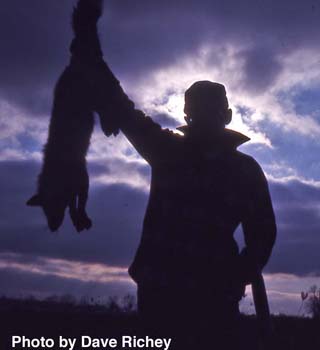
Brother George with a nice red fox he shot while doggin’ the tracks.


Many years ago there were far more red foxes than coyotes, and one of the things almost every winter day was to cut a fresh red fox track, and take off cross-country on foot along the straight-as-a-string trail.

Once I was driving to brother George's house, and spotted a fresh track that crossed the road a quarter-mile from his place. I stopped, got out of the car, and studied it. The track was smoking hot.

George and I put our heads together, and he felt the fox would probably skirt behind the barn, head off across the open field, hunt those fields for mice, and then settle down for a nap atop a clump of uprooted trees a half-mile from his house.

Two people working together is always a good plan.


We took turns dogging the tracks, and it was his turn. I'd lag behind, check ahead through binoculars, and try to make certain we didn't accidentally bump the critter. We headed out on the hot track, and the fox did cut behind the barn, moved down a hill, and crossed the field.

I glassed the track from cover, and lost them near a patch of sumac this side of a fence row 300 yards away, and on the other side of the fence was the tree-tops that would provide a sunny hiding place for a napping fox.

We eased through the field, spotted several areas where the fox had tried for a mouse, but the tracks stay straight until it came to a small knoll, and we bellied up to the edge of the knoll. More fox stalks are blown when people rush to see what is on the other side, and blunder into the fox. Once spooked, the animal will run for a long distance.

My head just eased over the top, and I glassed everything within view. The fox was nowhere to be seen, but its tracks cut through the field, into a cluster of sumac bushes near the hill-top, and we couldn't see the tracks past there.

We huddled, and whispered back and forth, and felt if the fox wasn't in the sumac, which we didn't believe possible, we'd have a reasonably clear look at the tree-tops. Perhaps the fox was already sunning himself.

I studied the sumac until my eyes were watering, and couldn't see tracks coming out. We had to keep going while we were fairly close to the animal. Stalling now could ruin the hunt.

We crossed the open field and approached the sumacs with caution. We could then see the fox tracks heading toward the fence line and the nasty mass of tree-tops scattered about like jackstraws.

Be ready to move but make sure the fox isn’t in sight before moving.


"I can see his tracks down to the fence," George whispered. "Check the tree-tops, and see if you can spot him. We'll stick out like two sore thumbs while crossing the field to the fence row."

Long minutes were spent glassing the tree-tops before I spotted the reddish-russet color of the bedded fox. He was facing away, directly into the wind, and we formulated plans. I would give George hand signals, and a palm raised upright meant for him to stop.

He watched a minute or two longer, saw the fox raise his head and check his back trail. We waited until he checked his back trail the second time, and we had five minutes. As soon as his head went down, George stayed low and ran for the fence only 40 yards from the fox.

He eased into place just as the fox's head came up to look around, and when it went down, I moved out. We met at the fence, and George pointed to a hole in the fence that would put him only 25 yards from the fox but he couldn't make a sound getting into position.

The fox looked around again, and when his head went down, George crawled to the hole, and snaked through. He had to depend on me now to tell him when the fox raised his head again.

Don’t shoot until the animal presents a clear shot.


Two minutes later the fox raised his head, and I made one small hand movement to George. He raised his 12 gauge 3-inch magnum, started to aim and the fox stood up when it caught the movement, and with one shot this fox hunt was over.

Stalking fox is no different than stalking bedded coyotes. Work into the wind, check closely before making a move, and when the stalk leads to a close shot, make it count. It's an exciting way to spend part of a mid-winter day, especially this time of year when foxes and coyotes are in the mating season, but not with each other.

The two species are deadly enemies, and a coyote will kill every fox they can catch. One rule hunters can count on: if fox are abundant, there aren't many coyotes around. However, if coyotes are thick, very few fox exist in the area.

Are you reading for the challenge of dogging a fox track to the animal's resting place. There's little margin for error.

Drove around square-mile sections until you find a coyote or fox track. Check the other roads to make certain the animal didn't cross out, and if it is still within the section, take up the track if you have permission to hunt someone else's land.

Move slowly with all possible haste, check ahead for the animal, don't move until the coast is clear, and always stay downwind if possible. It a great way to spend a snowy winter afternoon.

Posted via email from Dave Richey Outdoors