Showing posts with label cedars. Show all posts

Tuesday, May 03, 2011

Working on our tree stands


An open tree stand like this means a hunter can't move a muscle. I prefer more cover, especially on both side and above me.


I've hunted from wide-open tree stands and from stands that have just enough room through which to shoot. Which do I like best?

The answer, for me at least, is obvious. It's easy for me to sit still, and I'm always positioned so a buck will never wind me, but the truth is, either tree stand will work if the hunter is downwind from deer and can sit still.

My preference leans heavily in favor of cover. I love cedar and pine trees, and have been known to fill in a few holey spots with boughs cut elsewhere on my property. I don't want to be entirely screened by brush in a tree, but my idea is to have enough limbs and branches nearby to provide what I need for enough cover to break up my silhouette.

Work to mute the light from dawn or dusk to create shadows.


I like a mix of shadows and light, and an unbroken dark blob can be as revealing to a deer as a wide-open area with a big blob in the middle. The trick is to achieve some sense of shadowy balance; not too much and not too little.

The hunter needs enough room to draw, aim and shoot with a bow. The hunter doesn't need to be worrying about bumping limbs or hitting them while taking a shot. It's possible to be so concealed you can't shoot.

On the other hand, it helps to have some background foliage behind you. A good stand needs some cover to the right and left sides, and some cover from cedar or pine boughs overhead will add to the shadowed effect that we need.

What a deer sees is what is most important to hunters. All trees, even thick cedars and pines, have gaps where light shows through. I just don't want too much light shining through where I'm sitting. I want the area to be shadowed but not completely blacked out.

Create your stands now & brush them in early for deer season.


One trick some hunters use is to prepare their stand now. Hopefully they know where deer will travel, where they come from and where they go, and then have one person stand on the ground at the ideal location for a shot.

Study the area like an artist studies a landscape, and determine what needs some help in the way of pine boughs and what doesn't. Be careful when adding boughs so the fresh-cut limb ends will not be visible by deer. Heavy twine can be used to tie the boughs in place.

Have a buddy climb into the stand and you hunker down in a squatting position at the height of a deer's head, and study it. Pay close attention to what looks like the proper blend of shadows and softer but lighter areas. Limbs placed horizontally three or four feet overhead will add to the shadowed effect, and sometimes it is just a matter of putting a clump of pine needles in the right spot to make it work.

My reason for loving cedar and pine trees is there is year 'round foliage plus the natural scent of the trees. One hour of work on a tree stand can improve its effectiveness.

Of special importance is to complete this job as soon as possible. Don't wait until mid-September to do it or you are liable to spook deer from this stand location.

Do it right & ways in and ways out & it can be a good stand for years.


A buddy of mine had a similar set-up, and hunted the same tree for 10 years until someone sneaked in and started hunting it when he was elsewhere or not hunting that day. They rearranged pine boughs to suit themselves, and soon the stand was worthless.

Should you decide to do this, treat the area like it is your private morel mushroom patch or your favorite ruffed grouse or woodcock covert. Don't breathe a word of it to anyone, and hunt it by yourself.

Good stands remain good only as long as no one else can climb into them when the hunter isn't looking. Trespass on private land is a major problem, and hunters who brag about shooting a big buck from a particular area are simply offering others an unwelcome invitation.

Keep quiet, don't tell anyone where it is, and have two or three ways to get into it and out of it after hunting. Sometimes it's worth hiking an extra half-mile to avoid detection. All's fair in love, war and hunting whitetails from a tree stand.

Monday, February 07, 2011

Reading deer sign


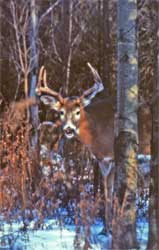
Reading deer sign can put a hunter close to a nice buck like this.


Reading deer sign is something that has always made sense to me. It gives me more knowledge of the animals, where they feed, where they travel, and in the end, it's this knowledge that makes hunters more successful while allowing them to accurately determine where best to set up their stands.

I'm so mindful of a big buck from several years ago. I'd seen him on three occasions but didn't know where he lived. It took me a week of reading October deer sign to pin down his whereabouts.

The area was in fairly heavy cover. I knew the buck had an exceptional 10-point spread, and reasoned he would be working over some big trees to strengthen his neck muscles before the rut began.

Check areas during mid-winter to find the latest buck sign on trees.


I'd moved slowly through the heavy cover without seeing much buck sign except for a few small rubs on some tag alders. I came out the other side of the tag alders, and entered a 25-yard by 25-yard stand of cedars and pines. That is when I worked out this whitetail puzzle.

One of those cedars was scarred by a pre-rutting buck. Lower limbs were broken off, and the trunk was scrubbed hard from a foot above ground to five feet off the ground. Mind you, I couldn't circle my arms around the tree trunk. This gigantic rub was truly huge.

Checking around let me find a faint trail that ran toward another cedar, and it too was rubbed by the same buck. Three trees within 25 yards formed a minor rub line, and the trail had exited the cover I had just walked through. This buck was leaving the tag alder to rub the cedar and pine trees, and most likely, the deer was moving out just before dark.

A nearby tree was perfect for a stand. There would be no clattering and banging required to erect a tree stand here. I'd attach a rope to my bow and my belt loop, lay the bow down flat, climbed 10 feet up the tree on limbs and stand on two thick parallel limbs that grew close together. Another limb came out at waist level, and I could stand on two limbs and lean back against the other one.

It wasn’t a long wait once I climbed into the tree.


Two nights later as the sun was sinking into the western sky I caught the glint of sunlight shining off brownish-white antlers. The buck went to the first tree, thrashed it hard for several minutes, looked around, and went to the second tree and repeated the process. Fifteen minutes later it arrived at the tree just 15 yards upwind of me.

It took a minute for the buck to rake the tree to a pile of fuzzy bark curlings at the base. He nosed his handiwork, lifted his head, moved around the tree to work on the opposite side. The deer was quartering-away at 15 yards, and it was an easy shot.

It's not my policy to advise anyone to stand on cedar or pine boughs and lean against another one, and I don't suggest you follow my lead. However, I knew the limbs would support me for one evening of hunting. I was certain it would lead to a shot at the big buck on the first night, and it did.

That buck was a creature of habit, and such habits can put a deer in trouble. Once the buck stopped rubbing and visiting the nearby scrape, this idea wouldn't have worked. My adventure with that big buck was timed perfectly, and that is where knowing something about the rutting activity comes in handy. From the end of October through mid-November, that tree might not have paid off as the buck hazed does through open fields and thick cover.

Hunting one buck is an adventure, a matter of going after them one on one. It means knowing as much about the area as is possible, and being able to translate that knowledge into an action plan.

There are countless other ways of reading deer sign that will pay off in a big way, and we will cover some other examples in the future. The important thing to realize is that studying deer sign is as much a part of deer hunting as carrying a bow into the woods.

Be alert to deer sign, read what it tells you, and you'll be on your way to becoming a much better deer hunter.

Sunday, October 17, 2010

Find hidden travel trails


Reading deer sign is something that has always made sense to me. It gives me more knowledge of the animals, where they feed, where they travel, and in the end, it's this knowledge that makes hunters more successful.

I'm so mindful of a big buck from several years ago. I'd seen him on two or three occasions but didn't know where he lived. It took me a week of reading October deer sign to pin down his whereabouts.

The area was in fairly heavy cover. I knew the buck had an exceptional 8-point spread, and reasoned he would be working over some big trees to strengthen his neck muscles before the rut began.

Big bucks make big rubs on trees.
I'd moved slowly through the heavy cover without seeing much buck sign except for a few small rubs on some tag alders. I came out the other side of the tag alders, and entered a 25-yard by 25-yard stand of cedars and pines. That is when I worked out this whitetail puzzle.

One cedar was scarred by a pre-rutting buck. Lower limbs were broken off, and the trunk was scrubbed hard from a foot above ground to four feet off the ground. Mind you, I couldn't circle my hands around the tree trunk. This big rub was truly made by a big buck.

Checking around was a faint trail that ran toward another cedar, and it too was rubbed by the same buck. Three trees within 25 yards formed a minor rub line, and the trail exited the cover I had just walked through. This buck was leaving the tag alder to rub the cedar and pine trees, and most likely, the deer was moving out just before dark.

A nearby tree was perfect for a stand. There would be no clattering and banging required to erect a tree stand here. I'd attached a rope to my bow and my belt loop, lay the bow down flat, climbed 10 feet up the tree and stand on too thick parallel limbs that grew close together. Another limb came out at waist level, and I could stand on two limbs and lean back against the other one.

A precarious perch but good enough for one night.

Two nights later as the sun was sinking into the western sky I caught the glint of sunlight hitting brownish-white antlers. The buck went to the first tree, thrashed it hard for several minutes, looked around, and went to the second tree and repeated the process. Fifteen minutes later it arrived at the tree just 15 yards upwind of me.

It took a minute for the buck to rake the tree to a pile of fuzzy bark curlings at the base. He nosed his handiwork, lifted his head, moved around the tree to work on the opposite side. The deer was quartering-away at 15 yards, and it was an easy shot.

I don’t advise anyone to stand on cedar or pine boughs and lean against another one, and I don't suggest you follow my lead. However, I knew the limbs would support me for one evening of hunting. I was certain it would lead to a shot at the big buck on the first night, and it did.

That buck was a creature of habit, and such habits can put a deer in trouble. Once the buck stopped rubbing and visiting the nearby scrape, this idea wouldn't have worked. My adventure with that big buck was timed perfectly, and that is where knowing something about the rutting activity comes in handy. From the end of October through mid-November, that tree might not have paid off as the buck hazed does through open fields and thick cover.

Hunting one buck is an adventure, a matter of going after them one on one. It means knowing as much about the area as is possible, and being able to translate that knowledge into an action plan.

There are countless other ways of reading deer sign that will pay off in a big way, and we'll cover some other examples in the weeks to come. The important thing to realize is that studying deer sign is as much a part of deer hunting as carrying a bow into the woods.

Be alert to deer sign, read what it says, and you'll be on your way to becoming a better deer hunter.

Posted via email from Dave Richey Outdoors